For over 80 years, Pioneer has been a name synonymous with the evolution of car audio, from the first component car stereos to the digital revolution of the 2000s. However, their latest reveal at CES 2026 represents more than just a seasonal upgrade—it marks a fundamental shift in how we experience sound on the move. The Pioneer Sphera is not merely another head unit; it is the world’s first aftermarket gateway to Dolby Atmos and spatial audio, bringing a studio-grade listening environment to millions of existing vehicles.
Historically, Dolby Atmos in cars was a luxury reserved for high-end factory systems in vehicles like the Mercedes-Benz S-Class or the Lucid Air. With the Sphera, Pioneer is democratizing this technology. Launching in Spring 2026 with a starting price of $1,300, this unit is designed to fit into a wide variety of dashboards, allowing drivers to bypass the limitations of standard stereo and enter a world of object-based audio.
What is the Pioneer Sphera?
The Pioneer Sphera is a 10.1-inch HD capacitive touch-screen head unit that serves as the centerpiece of a modern vehicle’s infotainment system. While it offers the features we’ve come to expect—wireless Apple CarPlay and Android Auto—its true identity lies in its ability to process spatial audio.
Unlike traditional "surround sound" which simply pans audio between left and right channels, the Sphera uses object-based audio processing. In this format, sounds are treated as individual "objects" that can be placed and moved within a three-dimensional space. To the listener, this means the lead vocalist can feel as though they are standing on the hood of the car, while the backing tracks swirl around the cabin, creating an immersive "bubble" of sound.
The Sphera is built on a modular single-DIN chassis, despite its massive screen. This design choice is critical for the aftermarket industry, as it allows the unit to be installed in millions of older vehicles that may not have the depth for a traditional double-DIN unit but have the surface area to accommodate a "floating" 10.1-inch display.
Hardware Specifications and Design
Pioneer has balanced aesthetic appeal with high-performance hardware. The Sphera’s interface is powered by the "Quick Swipe" UI, a system designed to minimize driver distraction while providing deep access to audio tuning parameters.
| Feature | Specification |
|---|---|
| Display | 10.1-inch HD Capacitive Touchscreen (1280 x 720) |
| Chassis Type | Single-DIN Modular Design |
| Connectivity | Wireless Apple CarPlay, Wireless Android Auto, Bluetooth 5.2 |
| Audio Output | 4 x 50W Built-in Amplifier + 3 Pre-outs (4V) |
| Special Lighting | Integrated Pioneer Luminous Bar |
| Launch Date | Spring 2026 |
| MSRP | Starting at $1,300 |
One of the most striking physical features is the Pioneer Luminous Bar located at the bottom of the screen. This isn't just for show; it operates in two distinct modes:
- Enhanced Visual Mode: Provides visual cues for navigation and safety alerts without the driver needing to look directly at the map.
- Music Synchronization Mode: The bar pulses and changes color in real-time coordination with the metadata of the Dolby Atmos track being played, extending the "vibe" of the music into the physical cabin.
How to Get Dolby Atmos in Your Car: A Step-by-Step Guide
While the hardware is impressive, the real magic happens through software customization. Getting Dolby Atmos to sound "right" in a car is significantly more difficult than in a living room due to the irregular shapes and reflective surfaces of a vehicle interior. Here is how you achieve that perfect spatial stage with the Pioneer Sphera.
Step 1: Professional Installation
The Sphera’s floating 10.1-inch screen is adjustable for depth, height, and tilt. Because the unit requires a stable power source and specific wiring to integrate with your car's existing speakers (or an external amp), professional installation is highly recommended. The unit’s single-DIN chassis ensures it can fit into dashboards ranging from a 2010 Toyota Camry to a modern Jeep Wrangler.
Step 2: Connecting Your Source
Currently, Dolby Atmos for the Sphera is primarily optimized through Wireless Apple CarPlay. To get the full spatial effect, you will need:
- An iPhone running the latest version of iOS.
- A subscription to a service that supports Atmos, such as Apple Music, Tidal, or Amazon Music.
- In the Music settings on your iPhone, ensure that "Dolby Atmos" is set to "Always On."
Step 3: Activating Pure Autotuning Technology
This is the most critical step. You cannot simply "turn on" Atmos and expect it to work with your car’s unique acoustics. You must engage Pioneer’s proprietary Pure Autotuning system.
Expert Tip: Pure Autotuning is the "brain" of the Sphera. It treats the car cabin not as a box, but as an acoustic instrument. By using a specialized microphone (usually included or available as an accessory), the system measures the distance from each speaker to the driver’s ears and analyzes how sound bounces off the windows and absorbs into the seats.
Step 4: Calibrating for Your Cabin
Once the calibration starts, the unit emits a series of test tones across the frequency spectrum. The proprietary algorithms then automatically adjust:
- Time Alignment: Ensuring sound from the rear-right speaker reaches your ear at the exact same millisecond as the front-left speaker.
- Frequency Response: Flattening out "boomy" bass caused by small trunk spaces or "tinny" highs caused by windshield reflections.
- Virtualization: Creating a 7.1.4 virtualized environment even if you only have standard factory speakers.
Understanding the Tech: Why Pure Autotuning is Critical
The primary challenge of automotive audio is the "off-axis" seating position. Unlike a home theater where you sit in the middle of the speakers, in a car, you are always closer to one side. This destroys the "phantom center" of a standard stereo image.
Pure Autotuning solves this by creating a 3D map of the interior. It accounts for the specific materials of your cabin—leather reflects sound differently than cloth, and a sunroof changes the resonance of the roof. By compensating for these variables, the Sphera places the listener at the "acoustical center" of the music.
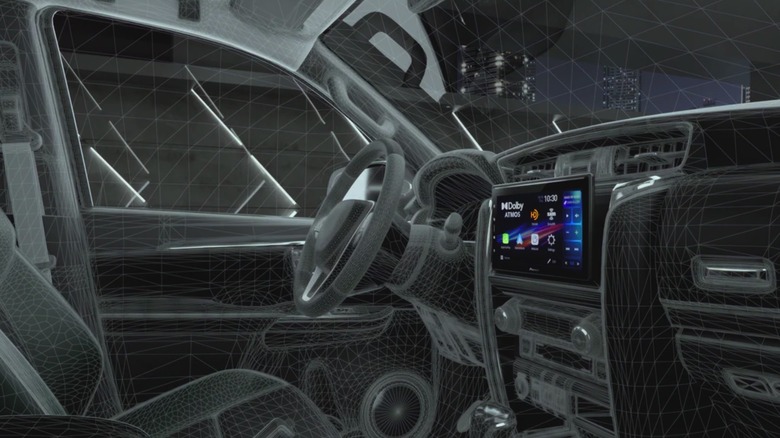
Furthermore, Dolby Atmos Music in automotive systems targets a specific loudness level of -18 LKFS. This is a technical standard designed to maintain optimal dynamic range. In a car environment, background road noise often masks quiet details. The Sphera’s processing ensures that the "quiet" parts of an Atmos track remain audible without the "loud" parts becoming distorted or overwhelming, maintaining the artist's original intent.
Comparison: Standard Stereo vs. Sphera Spatial Audio
To understand why this upgrade is worth the $1,300 investment, consider the difference in how sound is delivered:
| Feature | Standard Stereo Aftermarket Unit | Pioneer Sphera (Spatial Audio) |
|---|---|---|
| Soundstage | 2D (Left/Right) | 3D (Object-based, Height/Depth) |
| Calibration | Manual EQ / Basic Time Alignment | AI-driven Pure Autotuning |
| Immersion | Sound feels like it's coming from the doors | Sound feels like it's "in the air" around you |
| Listener Position | Optimized for one spot (usually driver) | Optimized for the entire cabin volume |
| Loudness Standard | Varies by source | Strictly -18 LKFS for Dynamic Range |
Compatible Content and Streaming Services
The Pioneer Sphera is built to leverage the growing library of spatial audio content. While Apple Music is currently the leader in Dolby Atmos tracks, the ecosystem is expanding rapidly.
- Apple Music: The primary partner for CarPlay spatial audio, offering thousands of Atmos-mastered albums.
- Tidal / Amazon Music: Both offer high-resolution spatial tracks that the Sphera can decode via wireless connection.
- Audible: Spatial audio isn't just for music; immersive "theaters of the mind" audiobooks are becoming a major draw for long-distance drivers.
- Android Auto Note: While Dolby Atmos is currently confirmed primarily for the Apple CarPlay interface on the Sphera, Pioneer has indicated that "more platforms and deeper Android integration are coming soon" via firmware updates in late 2026.
FAQ
Q: Do I need to replace my car's factory speakers to use the Pioneer Sphera? A: No. While high-quality speakers will always improve the experience, the Sphera’s Pure Autotuning is specifically designed to "virtualize" a Dolby Atmos environment using your existing speaker layout. It uses advanced DSP to make a standard 4-speaker or 6-speaker system mimic a 7.1.4 spatial setup.
Q: Is the Pioneer Sphera compatible with older cars? A: Yes. As long as your car has a standard radio slot (Single-DIN or Double-DIN), the Sphera’s modular design allows it to be mounted. The 10.1-inch screen "floats" in front of the dash, making it a viable upgrade for vehicles made as far back as the late 1990s.
Q: Does Dolby Atmos work over Bluetooth? A: No. Bluetooth does not currently have the bandwidth to support the data-heavy object-based metadata of Dolby Atmos. To experience spatial audio on the Sphera, you must use a Wireless CarPlay or wired connection to ensure the full bit-depth is maintained.
The Pioneer Sphera represents a milestone in the "software-defined vehicle" era. By moving the complexity of spatial audio from expensive factory hardware into a sophisticated aftermarket head unit, Pioneer has ensured that the future of sound isn't just for the 1%. If you are a dedicated audiophile or someone who spends hours in your car every week, the leap from stereo to Atmos is the single greatest upgrade you can make to your driving experience in 2026.