Our Top Picks
- The Verdict: A premium computing powerhouse designed for developers and early adopters who want a truly cable-free experience.
- Best Innovation: A sophisticated dual-chip architecture that cuts motion-to-photon latency down to just 7ms for seamless digital overlays.
- Overall Rating: The most advanced standalone spatial computing platform currently available in a glasses form factor.
Snap SPECS are premium, standalone ar glasses priced at $2,195 that represent the cutting edge of wearable technology. Powered by dual Snapdragon chips and the custom Snap OS, they deliver advanced 6DoF spatial tracking and high-quality graphics without needing a tethered smartphone or external battery pack, establishing themselves as a primary leader in the high-end ar glasses market.
The Standalone Revolution: Dual Snapdragon Architecture
When we talk about the evolution of ar glasses, the conversation usually splits into two categories: devices that look good but do very little, and devices that do a lot but feel like wearing a toaster on your face. The new Snap SPECS attempt to bridge this gap by packing an incredible amount of high-performance hardware into a frame that weighs significantly less than a VR headset.
The engineering feat here lies in the dual-processor setup. Instead of relying on a single chip to handle everything, Snap has split the workload. One processor is dedicated to running the Snap OS and managing standard applications, while the second processor focuses entirely on spatial tracking, hand-anchoring, and sensor fusion. This division of labor is what allows for the extremely low latency, ensuring that digital objects stay pinned to the real world even when you move your head quickly.
Weight is always a critical factor for wearable tech. The 47 mm model weighs only 132 grams, while the slightly larger 52 mm version comes in at 136 grams. By using Swiss TR90 polymer, often referred to as plastic titanium, the designers have balanced durability with a lightweight feel. While these are heavier than your average pair of Ray-Bans, they are remarkably comfortable for a device that contains its own cooling system and dual chips.
Perhaps the most surprising aspect of this standalone design is the battery life. While many high-end headsets struggle to reach the two-hour mark, these glasses offer 4 hours of active use. When you consider the ar glasses price of $2,195, you are paying for the freedom of movement. To keep you going through a full day, the device includes a portable charging case that can provide four full recharges before the case itself needs a plug. This makes it one of the few completely standalone ar glasses with snapdragon chips that you can actually use for extended professional work or travel.
Optics and Immersion: The 115-Inch Virtual Screen
The visual experience of the Snap SPECS is handled by advanced waveguide technology. These lenses are not just pieces of glass; they are sophisticated optical engines that reflect light from tiny projectors into your eyes. This results in a 57-degree field of view, which provides a generous canvas for digital content.
Visual Impact: Using Snap SPECS feels like looking at a 115-inch screen from about 10 feet away. The digital overlays are crisp, clear, and perfectly integrated into your environment.
One of the most practical features for real-world use is the inclusion of electrochromic lenses. In the past, ar glasses often struggled in bright sunlight because the digital images would appear washed out. Snap has solved this with lenses that can tint automatically. With a 10-second transition speed, the glasses can darken to block out ambient light when you are outdoors, ensuring that your virtual whiteboard or navigation markers remain visible.
This display quality makes them excellent ar glasses for gaming and virtual desktop use. Whether you are playing a game where monsters crawl across your living room floor or you are spreading out multiple virtual monitors in a coffee shop, the clarity of the Snap OS interface is impressive. The system uses liquid crystal on silicon (LCoS) technology to ensure that colors are vibrant and text is sharp enough to read without straining.
Snap SPECS vs. Xreal Aura: Is Standalone Worth the Premium?
The market for high-end wearables is heating up, and the most frequent comparison we see is the snap specs vs xreal aura comparison. Both are aiming to be the best ar glasses for power users, but they take very different approaches to how they handle computing power.
The primary difference is the tether. The Xreal Aura relies on a separate compute puck that you carry in your pocket and connect via a wire. In contrast, Snap SPECS integrate everything into the frame. While the Xreal Aura offers a wider 70-degree field of view, the trade-off is the physical cable. If you value a cable-free, ambient computing experience above all else, Snap is the clear winner.
| Feature | Snap SPECS | Xreal Aura |
|---|---|---|
| Retail Price | $2,195 | Approx. $1,000+ |
| Processing | Standalone (Dual Snapdragon) | External Compute Puck |
| Field of View | 57 Degrees | 70 Degrees |
| Operating System | Snap OS | Android XR |
| Weight | 132g - 136g | Approx. 80g (Glasses only) |
| Spatial Tracking | Integrated 6DoF | Integrated 6DoF |
Beyond the hardware, the ecosystem is a major factor. Snap has spent years building its AR platform, and there are currently over 450,000 developers who have created more than 5 million Lenses. This means that from day one, users have access to a massive library of content. While Xreal is making strides with Android XR, Snap’s head start in creator tools gives it an edge for those looking for the best high end ar glasses 2026 has to offer.
Privacy handled correctly is another way Snap stands out. The glasses feature clear, visible recording indicators that let others know when the cameras are active. This transparency is vital for public acceptance as these devices become more common in our daily lives.
Professional and Niche Utility: From Museums to Maintenance
While many people think of ar glasses as toy-like gadgets for social media filters, these specs are built for serious industrial visualization and professional utility. The accuracy of the ar glasses with 6dof spatial tracking allows the device to understand the geometry of a room with incredible precision.
In industrial settings, this technology is a game-changer. Imagine a mechanic working on a complex jet engine. With Snap SPECS, they can see digital markers pointing exactly to the bolts that need tightening, with technical manuals hovering in their peripheral vision. This hands-free interaction allows for faster, safer, and more accurate work. We are seeing similar applications in medical training and large-scale logistics.

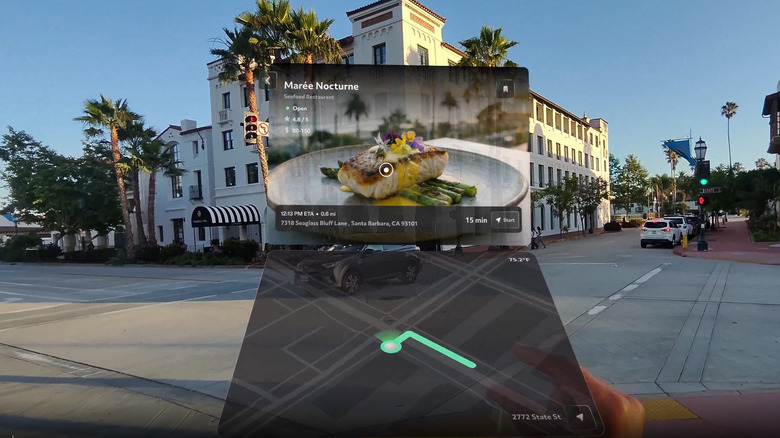
For the everyday user, the utility shows up in more subtle ways. Heads-up navigation is a standout feature; instead of looking down at a phone while walking through a new city, you see directional arrows appearing directly on the sidewalk in front of you. Education is another frontier, where museums can use the glasses to overlay historical reconstructions on top of ancient ruins, bringing history to life in a way a textbook never could.
Accessibility has also been a focus. Recognizing that many users require vision correction, the glasses support specialized prescription lens inserts. This ensures that everyone can enjoy the high-resolution display without having to stack the glasses over their own frames.
FAQ
What are AR glasses?
AR glasses, or augmented reality glasses, are wearable devices that overlay digital information, such as images, videos, and 3D objects, onto the user's view of the real world. Unlike virtual reality, which replaces your environment, ar glasses enhance it by allowing you to see through the lenses while interacting with digital content.
Which is better, AI or AR glasses?
Neither is inherently better as they serve different purposes, but the most advanced modern devices combine both. AI glasses usually focus on audio interaction and image recognition through a camera to give you information, while ar glasses focus on visual overlays. The latest high-end models use AI to better understand the physical environment that the AR content is projected into.
What are the best AR glasses on the market?
The answer depends on your needs. For those seeking a completely standalone, high-performance experience, the Snap SPECS are widely considered the best high end ar glasses 2026 offers. For users who prefer a lighter weight and don't mind a wired connection to their phone or a compute puck, Xreal and Viture offer excellent alternatives for media consumption.
Do AR glasses require a smartphone?
It depends on the model. Many consumer-grade glasses require a tethered connection to a smartphone to provide processing power and data. However, standalone devices like the Snap SPECS have integrated processors and their own operating system, meaning they can function entirely on their own without being plugged into another device.
Who is leading in AR glasses?
Currently, the market is a battleground between major tech players. Snap is a leader in the standalone and creator ecosystem space, while Meta is pushing the boundaries of what is possible with their Orion prototypes. Xreal remains a dominant force in the consumer market for wearable displays, and Apple continues to influence the high-end spatial computing market with its Vision OS platform.